Templates
For Full Community Sessions
On alternating Tuesday mornings, all staff gather for a full community session. To demystify what these sessions can look like and how they are designed, we have compiled the following practical resources: an agenda template that reflects the common components of full community sessions, our notes on what we’re learning about what works when designing and facilitating these sessions, and a library of illustrative COFG sessions intended to bring to life the wide range of learning experiences that take place when our community gathers.
Fetzer’s Agenda Template for Full Community Gatherings
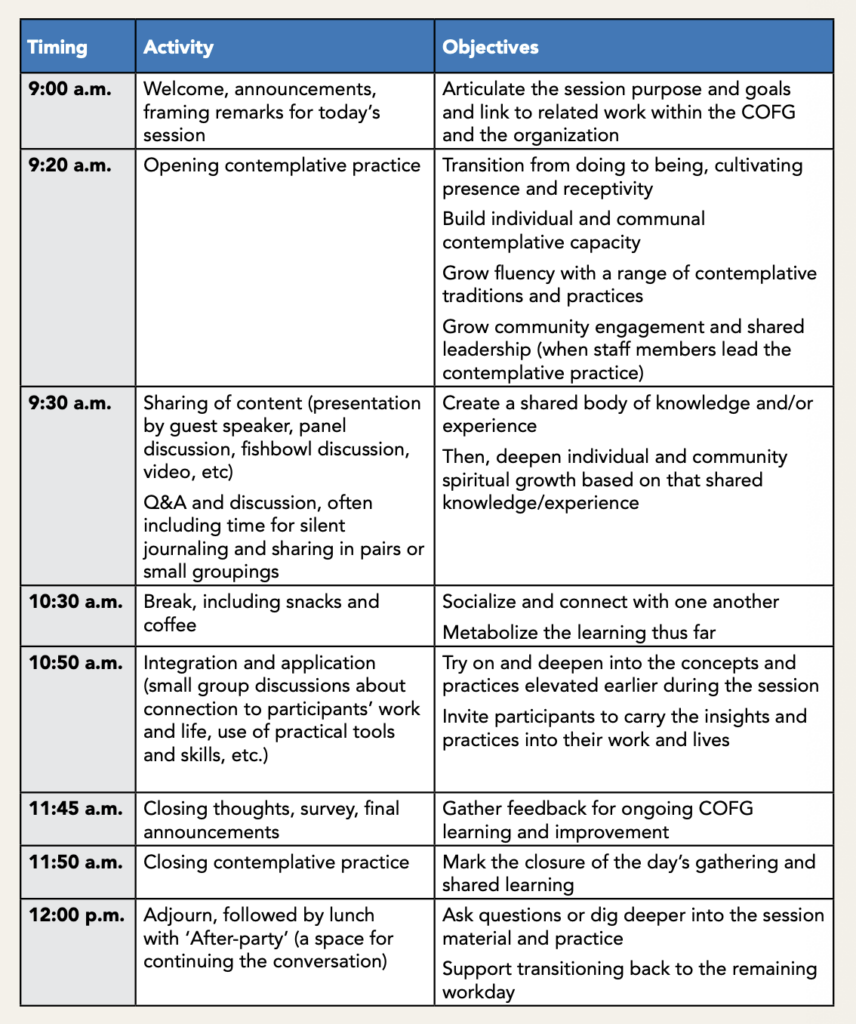
Roles and responsibilities for preparing, hosting, and facilitating full community sessions:
- Dedicated COFG staff hold and host the space. They do the welcome/opening announcements and the closing announcements. Oftentimes they will lead the opening and closing contemplative practices and frame the session.
- Other community members often engage with COFG staff to co-design and co-host sessions. Co-hosting often includes (but isn’t limited to): leading opening and closing practices, offering opening framing remarks, and personal storytelling or speaking on panels during the ‘sharing content’ segment.
- Outside presenters or facilitators are often invited to facilitate interactive group dialogue and reflective practices, present on topical areas, and offer contemplative practices. COFG staff work closely with outside facilitators to design and collaboratively hold the space in alignment with the larger intentions of the COFG and development arc of the community.
What Works When Designing, Hosting, and Holding Our Full Community Gatherings:
- Create spaciousness in the schedule. Resist the urge to try to ‘fit it all in.’ Spaciousness is an important adult learning and design principle and supports cognitive and spiritual development because it invites better integration. In addition to allocating ample time for each activity, honor breaks and mealtimes as sacred practice.
- Breaking for a significant amount of time (~20 minutes) and offering food during that time is an important part of the COFG design. It provides a pause during which participants can recharge, connect, and begin to process their learning and experience.
- Sharing a meal creates space for deepening community. At Fetzer, staff can gather for lunch in a shared lunchroom on Monday through Friday. On Tuesdays after full community sessions, we reserve one table in our shared dining room for an ‘After-party’ where community members can debrief and continue discussion of the day’s session.
- Repetition (plus variation) is vital. Repeating a similar gathering structure for each session creates a ritualistic experience; it helps participants feel at ease because they know what is coming next. This establishes a familiar and safe container for learning and growth. Within this container, we experiment with novel facilitation methods and approaches to meet different learning styles and activate continued interest — for example, by integrating art, music, poetry, and diverse processes for large group dialogue like World Cafe. This is aligned with adult learning principles.
- Design for continuity between sessions. Many of our full community sessions are organized as a series of three or four sessions spread throughout the year. Together they unpack a concept (like world religions), a practice (like contemplative practices), or a competency (like communal discernment). This helps participants longitudinally deepen their learning, cultivate their practice, and build their skills over time.
- Open doors and invite curiosity. Many topics related to spirituality and religion are impossible to ‘teach’ in a single session. We have found this to be especially true for our World Religions sessions; during these sessions we find it most impactful to offer a brief framing, then introduce a key tenet of the tradition, followed by a related practice.
- Engage practitioners with interspiritual formation skills. In order to do no harm and advance individual and communal spiritual development within our diverse context, we prioritize engaging outside speakers and facilitators who are fluent with spiritual formation and skilled at engaging a spiritually pluralistic community.
Library of Full Community Sessions
The Full Community Session calendar is intentionally designed around principles of adult learning and development. Through the complementary structures of content and capacity-building sessions (along with resources for individual learning and emotional and spiritual supports) participants develop personal, relational, organizational, and spiritual capacities over time. This development framework takes a holistic approach to guiding our annual curriculum planning. While individual sessions vary from year to year, each contributes to the following broader areas of learning and formation:
- Engaging with difference and cultivating belonging
- Spiritual practice and integration
- Capacity building
- Strategy
The following descriptions provide a view into the variety of learning experiences offered during full community sessions. These are a small sample of the full array of actual COFG sessions.
Engaging with Difference and Cultivating Belonging
In these sessions participants develop the capacity to engage differences with curiosity, deepen religious and cultural literacy, cultivate belonging, and build the relational skills needed to work across diverse perspectives. For example:
Islam: A Sacred Pilgrimage
- Why: To help deepen religious literacy, authentically engage with difference, and develop a shared language for dialogue about religions and spirituality.
- How: A Muslim scholar practitioner led the community through an exploration of the rituals and historical roots of Hajj– the Islamic pilgrimage to Mecca. The session included interactive presentation and dialogue, personal reflection, and guided meditation.
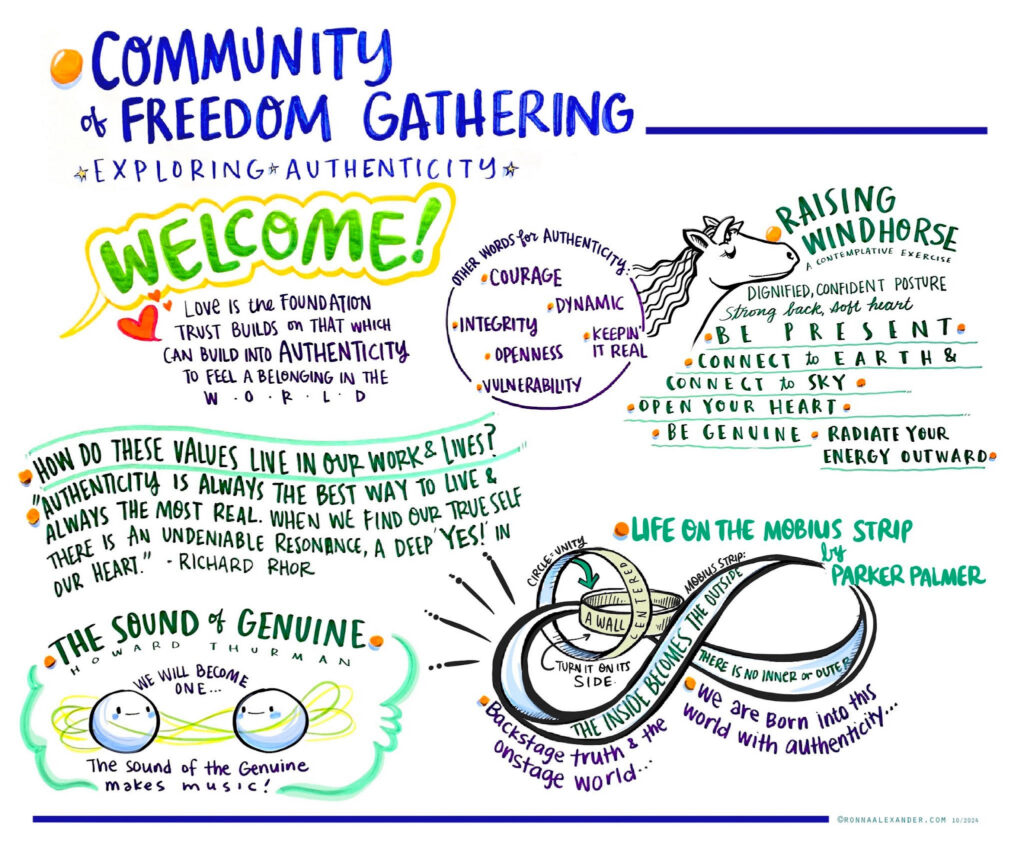
Exploring Authenticity
- Why: To deepen staff understanding and embodiment of authenticity (one of Fetzer’s four core values) both in personal lives and in our communal work at Fetzer.
- How: Fetzer leaders shared their personal stories of authenticity, followed by exchange in small groups, journaling and paired reflection, and large group discussion on what it means to bring one’s full, authentic self to a spiritually-grounded workplace.
Bridging & Belonging
- What: To engage our Bridging & Belonging work as a community and deepen participants’ understanding of foundational concepts of Bridging & Belonging; and thereby grow awareness of how core bridging and belonging concepts connect to their everyday work and leadership.
- How: Participants were introduced to key concepts for enacting bridging and belonging at Fetzer; then through reflection, art making, and small group dialogue, they explored what these concepts mean for themselves, their teams, and their shared responsibility to create a community of belonging.
Spiritual Practice and Integration
In these sessions, staff cultivate their inner lives through diverse contemplative and spiritual practices. Individuals can then integrate these practices into their life and work, and across the organization. For example:
Setting a Spiritual Intention
- Why: An annual opportunity for community members to listen to what is calling them and set an intention for their spiritual development in the year ahead.
- How: Two external spiritual leaders and teachers led participants through a series of individual and communal reflective practices, including using music to reflect on what has shaped us and how we would like to shape our future, and small and full group dialogue about emerging hopes for the future. The session was held virtually for all participants.
Suite of Contemplative Practices
- Why: To cultivate internal leadership and ownership of our communal spiritual life, staff share practices that help colleagues know one another more deeply, honor the diverse wisdom and spiritual traditions within our community, and introduce staff to different contemplative practices across traditions. The Suite of Contemplative Practices session is a community favorite that is held two times a year.
- How: Community members offer a curated set of contemplative practices, such as improvisational music circle, contemplative pie dough making, eating with intention and reciprocity, lego building, yogic breathwork and nature walking. Participants self-select into two rounds of small groups organized around each contemplative practice.
Seeing Spirit in the Everyday
- Why: To expand participants’ understanding of the Sacred, promote interfaith dialogue, and cultivate belonging.
- How: A guest speaker/facilitator of interfaith engagement through photography led participants through an activity in which they were invited to bring photos they had taken of what Spirit means to them in their daily life, share their photos in small groups, and together explore the many ways community members can see Spirit in the everyday.
Music is Medicine
- Why: To bring love, intention, reciprocity, community, and energy to musical experience and thereby experience the Sacred through music
- How: Members of a local “music medicine” collective offered meditative and contemplative music. The session included story, readings, instruments, call and response, and ancient and traditional songs.
Capacity Building
These sessions are designed around developing the skills and capacities required for fostering a spiritually grounded organizational culture. For example:
Art as a Catalyst for Looking, Listening, Dialogue, and Community
- Why: To grow the community’s capacity to slow down, listen, notice, and engage in collaborative dialogue across difference, using art as a pathway into dialogue that engages our whole selves.
- How: Guest speakers/facilitators of a research-backed method for looking at art together met with community members at a local museum where they led small groups in an open and collaborative art conversation.
Strategy
These sessions help staff connect their individual work with the Institute’s broader mission and strategy, creating shared understanding, alignment, and ownership across the organization. For example:
Programmatic Strategy
- Why: To have open conversation about Fetzer’s strategy to empower a movement of funders and organizations that are applying spiritual solutions to social problems; and thereby help staff across all levels of the organization better understand and integrate our programmatic strategy and the rest of our work.
- How: Senior leaders facilitated two fishbowl conversations: one among leaders about how the strategy is playing out, and one among staff about what would help them feel more connected, aligned, and effective in bringing the strategy to life.
Looking Back & Moving Forward
- Why: An annual opportunity for the community to reflect on the year that is coming to a close, and dream about what could be possible in the year ahead –for their own spiritual growth and for the community. In addition to community-building, it also offers another way for the COFG planners to get input and feedback from the community in the design of the upcoming year.
- How: COFG staff share a ‘year-in-review’ — reminding the community of the year past and the collective spiritual journey we’ve been on, what was learned and achieved; followed by self-reflection and collaborative intention setting for how the community can, together, center the Sacred in the coming year.
Download
Download the complete PDF case study below.