A reflection on spiritual imagination from the first Global Conscious Food Systems Summit, Bhutan
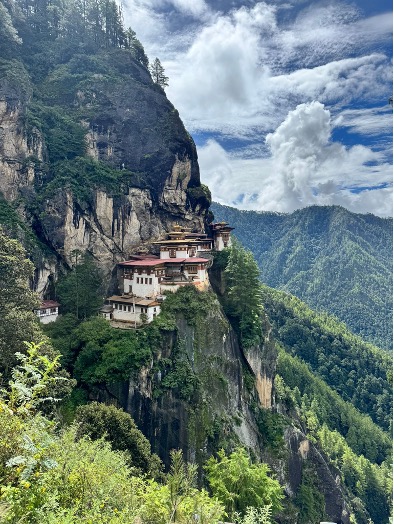
The journey from the United States to Bhutan took me fifty hours, door to door, and by the time I landed in Paro I had lost count of the time zones somewhere over the Pacific. Still, something in me had arrived before the plane did. I felt it the second the wheels touched the runway, not excitement exactly, more like recognition, almost a homecoming, in a country I had never once set foot in. The mountains. The water. Buffalo grazing on terraced slopes. Farming and faith and season and ritual, not separated into different categories the way we tend to do it, but woven into one thing. It reminded me, more than I expected, of the small village in southern China where some part of me has never really left, even after twenty-five years in the West. I think I fell in love before I’d even unpacked.
I’m not telling you this just to set the scene. It’s actually where I want to start, because I’ve come to believe that some of the most important knowledge we carry about healing our food systems, and our world, isn’t conceptual at all. It’s somatic. Ancestral. It lives in the body long before it ever reaches the mind.
I went to Bhutan for the first Global Conscious Food Systems Summit, convened by the Royal Government of Bhutan, the Conscious Food Systems Alliance, and the United Nations Development Program. The Fetzer Institute was one of the funding partners, through our Environment Collaborative’s work to center the sacred in its work, on sacred-centered worldview transformation, which is part of why I was there at all.
Nearly 400 people gathered in Paro from around 65 countries. Farmers and prime ministers. Indigenous leaders and scientists. A former UN Secretary-General and a former President of Ireland, along with many ministers. Business executives, mindfulness teachers, international representatives, local voices. I still don’t quite know how the Conscious Food System Alliance (CoFSA) team pulled off the logistics of that. Several hundred more joined online, held in accompaniment by Alef Trust across five global regions. My friend Dr. Jessica Böckler, who helped coordinate that online presence, wrote afterward that it was extraordinary to hear people speak about consciousness not as some private, esoteric matter, but as something woven directly into conversations about policy, finance, food security, and the dignity of the people who actually grow what we eat. I felt that too, every day.
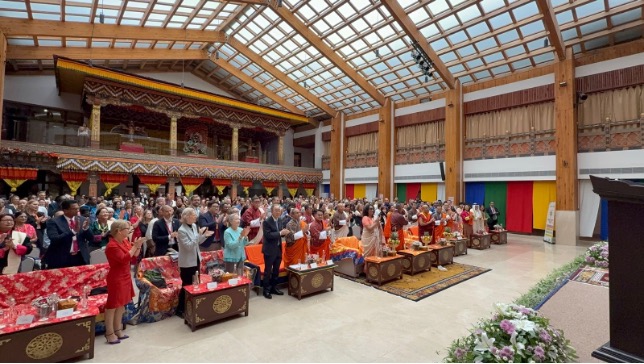
Bhutan’s Prime Minister Tshering Tobgay opened the summit by asking us to look down at our own breakfast plate and actually see it: the farmer, the farmer’s family, the soil, the water, the future being planted or foreclosed in every single choice along the way. Such a simple question. It undid me a little, sitting there with my coffee going cold. In Tobgay’s book, Enlightened Leadership: Inside Bhutan’s Inspiring Transition from Monarchy to Democracy, he writes about wisdom, compassion, and courage as three things that can’t really be pulled apart: the wisdom to see what’s unseen, the compassion to let that seeing actually move you, and the courage to act on it anyway, even when it costs you something. I’ve encountered very few leaders who carry that framework as visibly as he does, and his humility and his very dry sense of humor sat right alongside it, which somehow made the whole thing more credible, not less.
On our first full day, we visited a Mountain Hazelnuts Farm. I knew that it was a private company, one of Bhutan’s largest employers, working with thousands of farming households across nearly every district in the country. What I didn’t expect was morning meditation built right into the workday, altars in the offices and in people’s homes, prayers offered at the temple for gentle insect management instead of eradication. This company’s business structure, its agronomy, its supply chains, its shareholder logic, is nested inside an inner architecture of reverence, and I’m still not sure I have the language for how that actually looked in practice. I could see it in the farmers’ eyes though: bright, hopeful, unmistakably theirs. It’s one thing to read about Bhutan’s Gross National Happiness. It’s a completely different thing to stand in a field and watch someone live it.
That tension, between the outer work of transformation and the inner ground it grows from, ran through the entire week. Andrew Bovarnick, who founded the Conscious Food Systems Alliance five years ago, told a few of us that he’d always known Bhutan would be the first government he approached, because this is roughly the direction he hopes every country might eventually travel: an approach to food systems that incorporates a conscious connection to nature, spirituality, kindness, compassion, enough to actually shape policy and finance and how the UN convenes its own meetings.
Cecilia Magarotto, an agriculture specialist I was lucky enough to become fast friends with there, came at the same idea from a completely different angle, drawing on years at the World Bank. No food system can call itself conscious, she said, without genuinely recognizing grassroots leadership, because communities given real agency build far more than any project indicator was ever designed to capture. And Elise Buckle shared a line from Mary Robinson that has stayed lodged in me ever since: Women carry the seeds of hope the way African slaves once carried seeds for food sovereignty, hidden in their hair, crossing the ocean. I don’t think I’ll ever look at a seed the same way again.
By the third day, the questions had turned practical. Bhutan’s Minister of Agriculture and Livestock, Younten Phuntsho, asked the room what prosperity is actually for, insisting that growth and wellbeing, culture and nature, were never meant to be pulled apart in the first place, and that lasting prosperity comes through cooperation rather than competition alone. Four cities brought their own proof of that: Budapest redirecting food surplus, Turku redesigning food aid around dignity, Toronto nourishing its students, Medellín treating food as a right. By the fourth day we were sitting with something harder than inspiration, which is how you actually pay for a shift like this, at scale, across governments and communities and generations that haven’t been born yet.
I was also given the chance to speak, and something moved through me that I honestly hadn’t planned for. I asked the room to just look out the window for a second: no air out there is broken, no water, no energy, no spirit. Any sense of separation between us, I said, is an illusion we’ve talked ourselves into. Bhutan itself seemed to be teaching me this everywhere I turned, through the eyes of Buddha painted on temples and prayer wheels all across the valley, watching in every direction at once. There’s no outside in that gaze, and no other, just the plain reminder that we’re never separate from the divine, because we already are it, and most of the time we’ve simply forgotten to notice. I remembered John Fetzer, my foundations founder, too, who believed that if you listen closely enough you’ll eventually hear the ring of truth. He spent much of his life trying to build a community grounded in freedom: freedom of expression, of thought, of movement, of will, and, he insisted, freedom of spirit. Whatever shape the truth takes, he believed the final verdict would be unconditional Love.
That word, consciousness, got defined about a hundred different ways that week, by farmers and ministers, mystics and economists, each of them shaped by their own path and their own work. I loved that about it, honestly. But somewhere in the middle of all that beautiful multiplicity, I kept coming back to a quieter question of my own: Is there shared ground underneath all of it, something big enough to hold every single definition without flattening any of them? My best guess, for now, is unconditional Love.
Outside the summit halls, Bhutan kept teaching me the same lesson in smaller ways. Everyone, and I mean literally everyone I crossed paths with, was so kind to me, in a way that stopped feeling like coincidence after the third or fourth time it happened. A roadside sign read, simply: No hurry, no worry? Horses and buffalo lay down in the middle of the road, and every car just waited, treating the animal less like an obstacle and more like a kind of sacred presence passing through. Everything there seemed to have already agreed, long before any of us showed up, to slow down. I’d read about Gross National Happiness from the West for years, and it always sounded like a lovely, faintly radical idea. Standing inside it, it stopped sounding radical at all. It started feeling like memory.
For full transparency, I did not sleep well that week, three, maybe four hours a night, and I honestly couldn’t tell you why, the altitude, the jet lag, or some quieter, subconscious part of me that knew this was a once-in-a-lifetime kind of presence, not something to be slept through. Whatever it was, I wasn’t tired. I was awake in a way I don’t think I’ve been in years.
If there’s one thing I want to carry out of those mountains and into the work ahead, at Fetzer and beyond, it’s this: Spiritual imagination might be one of humanity’s biggest untapped assets in the work of transforming our food systems, and everything downstream of them. Not spirituality as private comfort. Not imagination as fantasy. The two together, as a way of seeing what isn’t yet visible, and having the nerve to build toward it anyway, the wisdom to see it, the compassion to actually care, and, like the Prime Minister said, the courage to act on it.
I’m still there, in some sense, among those temples and rivers and all that chanting. I suspect I will be for a while yet. But I’m also fully back here, and something in me feels sharper for it, a keener sense of what’s actually possible. In two days I’ll be hosting another Fetzer gathering, this time for Climate Week here in New York City, and I’m walking into that Lee Bollinger Forum carrying Bhutan with me. I don’t know yet exactly what that will look like once we’re in it. I just know I’m not walking in as the same person who left.