For much of my life, I had been surrounded by religious rituals and altars, both in my upbringing as a Mexican Christian and through my work with the Lutheran church. But it was not until the death of my infant nephew that I came to understand what these practices could truly hold.
In 2024, my baby nephew Sebastián died. As my family gathered in Mexico to share their grief, I was here in the United States, and never before had I felt the distance as acutely. It was a physical feeling. Living away from home means missing the ordinary things: the Sunday meals, the celebrations and the arguments, the big moments and the small ones. Grief sharpens that distance. You want to be in the room with everyone else, but you are not. You cannot hold anyone, and no one can hold you.
I wanted nothing more than to comfort my sister, but nothing I could think of felt big enough.
So, I offered what I actually had. I am Lutheran, formed by my church, and all I could give was a service. When we gathered to commemorate Sebastián’s short but significant life, we built a small altar with his photograph and his ashes.
Amid our collective grief, I saw the altar as a focal point, something to look at as we worshipped and prayed.
Then I watched my niece approach the altar.
She was six years old and experiencing the loss of her baby brother. Nobody explained the altar to her, and nobody needed to. She stood in front of it, spoke to it, and returned again and again, with a seriousness that matched everything she was taking in and a playfulness only a child could bring. At one point she picked up the urn that held her little brother’s ashes and held it to her ear, trying to hear what was inside.
As I think back on that memory, one that has stayed with me since I witnessed it, I can only describe what I saw as sacred. My niece, not yet old enough to understand or verbalize the complexity of her feelings and the depth of her loss, had a relationship with her brother’s memory. The altar was where that relationship, cut short in life, could continue. It was the place where she could still be with her beloved brother. I have thought about my niece in front of that altar more than almost anything else in my life.
My niece taught me that an altar is not decoration, and ritual is not performance. An altar is a place we build so that connection becomes possible. It gives our love somewhere to go. When we have no words, and no gesture large enough, the altar holds what we cannot hold ourselves. My niece seemed to understand this instinctively, before she had learned to doubt it.
A Tradition of Remembrance
This is why Día de los Muertos, or Day of the Dead, holds such meaning for me. It offers a way to remain in relationship with those who have died, bringing families together across generations in remembrance. It holds mourning and celebration side by side, honoring the lives of those who have passed while affirming the bonds that remain.
The tradition has deep roots in Mexico’s Indigenous cultures, with practices and beliefs that have evolved over centuries and intertwined with Catholic observances, including All Saints’ Day and All Souls’ Day. Among the ancient traditions of the Aztec people was the belief in Mictlán, an underworld the dead journeyed to after death. Today, Día de los Muertos is celebrated in diverse ways across regions and families, reflecting a rich and evolving cultural inheritance.
As a Lutheran, I recognize a kindred impulse in my own tradition. In North America, many Lutheran communities observe All Saints’ Sunday near the beginning of November to remember the faithful departed. For some Mexicans who are agnostic or do not practice a religion, Día de los Muertos is also a cultural and personal celebration of family, memory, and the continuity between generations. These traditions are different, but each offers a way to honor those who came before us.
For me, they meet in the conviction that remembrance matters; that the lives we have lost remain part of the lives we continue to live.
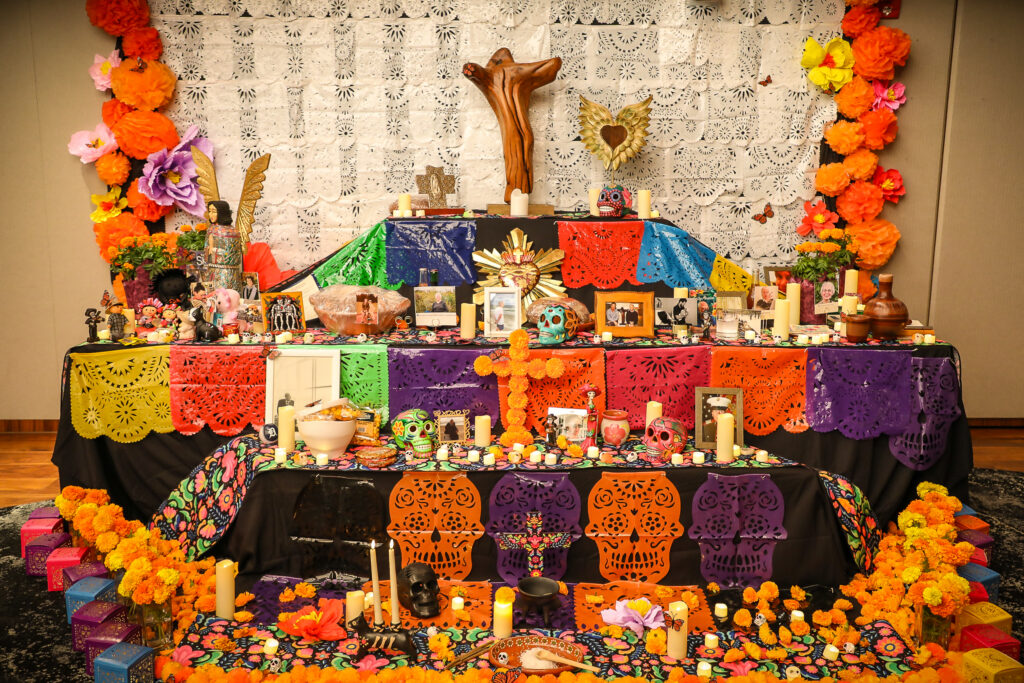
The ofrenda, or altar, is the heart of Día de los Muertos celebrations, where we invite our loved ones to visit us in spirit. Each item on the ofrenda holds special significance, creating a sensory experience that guides our loved ones’ souls back to us, even if only for a night.
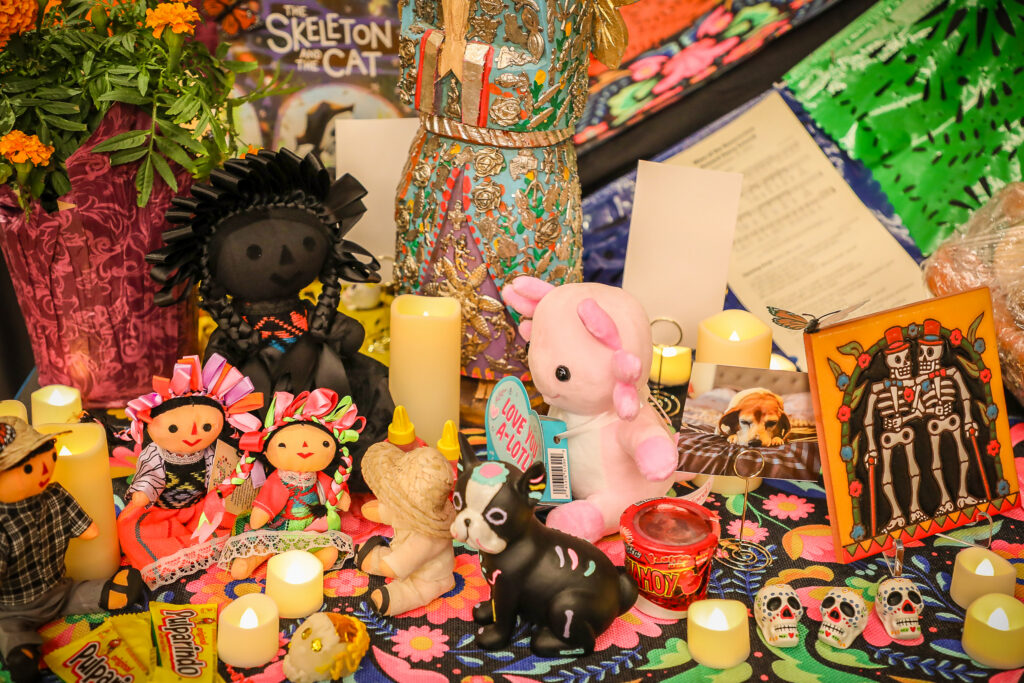
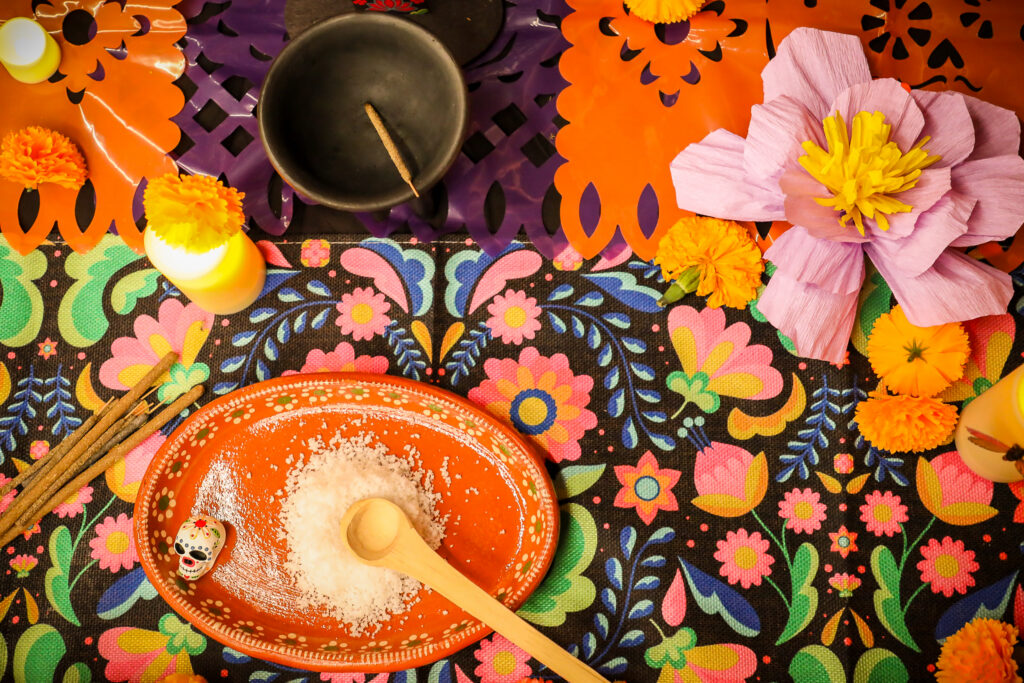
No two ofrendas are alike, but many include marigolds, or cempasúchil, whose vivid orange petals and distinctive fragrance are believed to guide the dead. Candles light the path. Copal, a tree resin burned as incense in Indigenous ceremonies, sends its smoke upward with prayers. In Aztec belief, the god Xolotl created a dog called the Xoloitzcuintli to guide the dead through Mictlán, the underworld; and especially to accompany the souls of children, the innocent ones, so that they would never make the journey alone. After a long journey, spirits drink water and find their favorite foods on the table, including pan de muerto, mole, fruit, chocolate, and atole. A framed photograph takes the place of honor, and a favorite book or piece of clothing makes the altar personal. Papel picado, cut tissue paper, stands for wind, and its delicate designs represent the fragile union between life and death. Salt stands for purification. Sugar skulls, calaveritas, sometimes carry a loved one’s name and stand for both death and the sweetness of life.
There is also a special space that is dedicated to the souls of children, our angelitos, or ‘little angels’. This part of the altar is decorated with toys, candies, and colorful decorations, reflecting the innocence and joy of childhood.
What moves me most is how these objects make remembrance tangible.
Memory happens inside our own heads, and we often hold our grief close to us, internal and unspoken. The ofrenda gives it company. It invites us back into our relationship with those who have passed. Through the marigolds, candles, water, photographs, and food, the distance between the living and the dead becomes something we can approach, even if only for a moment.
These objects form a vocabulary for what words cannot express. When we honor the sacredness of the people we have lost, we are reminded of our own. We remember that we belong to something longer than the present moment, that we continue the people who loved us, and that someone will one day set out marigolds for us.
An Altar We Build Together
This year, the ofrenda at the Fetzer Institute is a community offering. Colleagues have brought photographs, objects, and mementos of people they love. Faces I have never seen before and objects whose stories I do not yet know rest alongside my own.
One family’s altar and a community’s altar do the same work and share the same message: none of us carries our dead alone. We gather in their honor. Though they have left this world, they remain in our hearts, in our stories, in the way we live, and in the way we love.
The Fetzer Institute’s mission is to help build the spiritual foundation for a loving world. I have come to believe that such a foundation is laid in modest acts: a table, a photograph, a name spoken aloud among colleagues.
An ofrenda asks very little of us. It asks only that we make room.
Around our ofrenda, we hold a remembrance service. A bell sounds once after each name, carrying it into the silence and allowing the silence to hold it. We read names from our community one at a time. Anyone who wishes may speak the name of a beloved person who has died, or hold that name quietly in their heart. The bell rings for them, too.
We remember their laughter, their wisdom, and the gifts they shared with us.
Then we answer a litany together. Each line remembers someone: those who first taught us to wonder, those whose hands built the places we call home, those who died too soon, and those whose names no one speaks anymore. After every line, we offer the same response:
We remember you, and we give thanks.
You can do this practice wherever you are. Set out a photograph, a candle, a glass of water, and something they loved, whether a favorite food or an object that brought them joy. Say their name. If you have a bell, ring it once. If you do not, let a moment of silence do the same work. You do not need to follow a particular tradition or have the right words. You only need to make a little space for remembrance.
When you are ready, borrow the words that close our service, which turn the altar into a blessing for the living: may your life be a community offering, layered, generous and open to wonder.
Vayan en paz. Go in peace. Go and be free.
The altar at the Institute will stay up through November 3. Everyone in our Fetzer community is invited to come, say the name of someone they love, and spend a few minutes in their company. To readers elsewhere, I offer the same invitation: wherever you are able, build your own version of the altar, to be with the ones you love.
That is all my niece did. She was simply with her brother.