Resourcing Sacred-Centered Community and Culture
We often get asked, “What does it cost?”
2025 COFG costs included $105,000 in program operating costs, plus full salaries for two FTE (our COFG coordinator and our spiritual care director), 20% of our Organizational Culture VP’s salary/time, and three hours a week for all staff participation. We appreciate that Fetzer’s investment in its sacred-centered community is significant.
Here’s the good news: our experience suggests that there are different models requiring differing levels of resourcing that organizations can entertain. At Fetzer, our intentional embodiment of a sacred-centered community started with the support of a part-time consultant/spiritual formation practitioner while mobilizing shared leadership across staff. As our commitment to the community and the aligned organizational culture has grown, so has our commitment of financial resources.
Below, we outline three different models for consideration, all of which we have experimented with at Fetzer, and our estimate of associated costs (based on our experience and context).
These economic models include:
- Program operating costs — guest honoraria and travel, contracted partners, full community gathering materials, and supplies and resources to support small group and individual spiritual exploration
- Dedicated staffing — salaries, benefits, and development for staff whose role it is to lead this work.
These economic models do not include:
- Participating staff time — the hours the whole staff spends in the practice each week. Of course, this is highly variable depending on your organization’s size and salaries.
- Wrap-around spiritual formation benefits. At Fetzer, we offer a suite of benefits that help deepen individual staff members’ spiritual growth and well-being. These include access to a $2,000 stipend and time off for all staff to pursue a spiritual formation opportunity once a year. Similar to professional development investments at other institutions, such benefits help staff deepen into their own spiritual journeys, which also reinforces the work of the COFG.
We offer our calculations as a starting point — one input for your planning, in your context. As you review these models, we invite you to consider:
Is leadership ready to commit the resources — both staff time and direct program operating costs — needed to make this a reality?
What assets do you have in your organization? How might staff members come together to co-create your spiritual community?
Do you have the capability (via internal or external expertise and capacity) to facilitate meaningful spiritual learning and practice across diverse religious, spiritual, and wisdom traditions? In our experience, expertise in adult learning and development and in facilitating such interspiritual formation has been critical to ensuring that community members are not harmed and feel invited into spiritual growth. We recommend prioritizing dedicated resources here.
What is a ‘good enough’ starting point for your organization and your context? Allocate just enough resources and evolve your resourcing to match shifting needs, as you’re able.
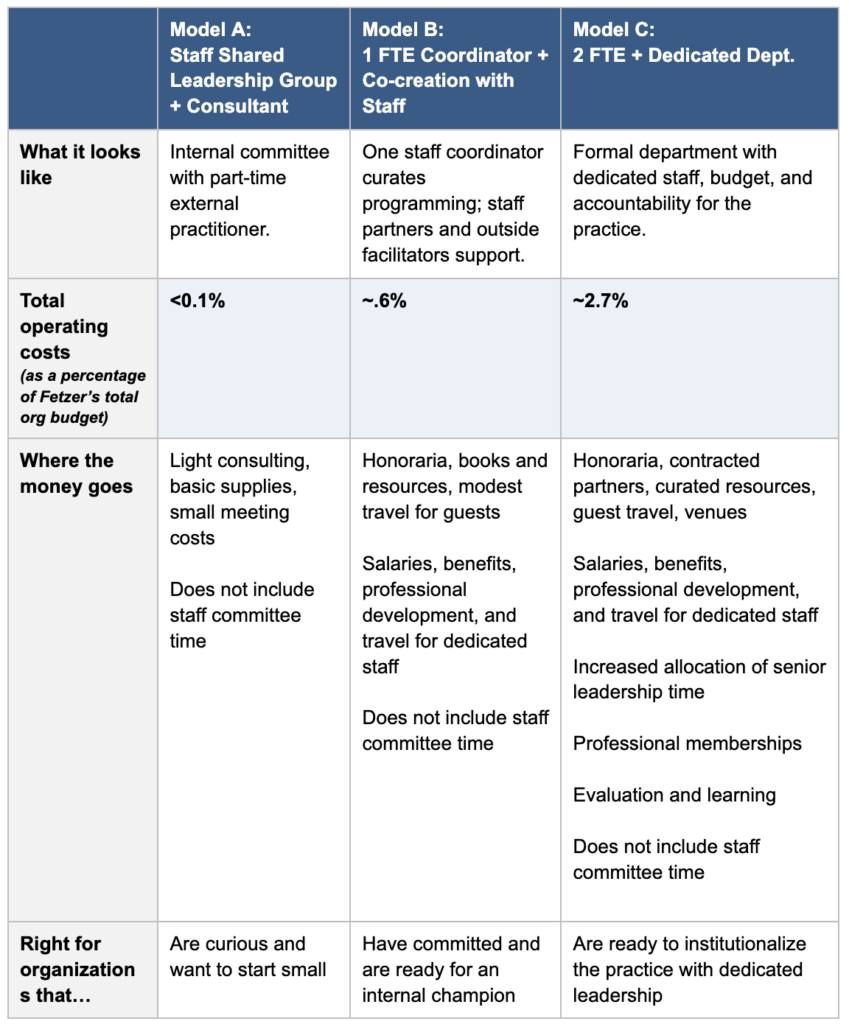
Model A: Shared Staff Leadership and Part-Time Consultant
When Fetzer began convening its weekly spiritually-rooted gathering for all staff, it was a full community effort. Staff assumed a range of roles and it was coordinated and facilitated by a committee that included staff leaders and a contemplative educator (who engaged as a part-time consultant).
The cost for this model was less than 0.1% of Fetzer’s organizational budget (not including time for staff who were collaboratively guiding the work).
This model could be a helpful entry point for organizations getting started with cultivating sacred-centered community. It offers space for experimentation and cultivated shared community ownership while responsibly stewarding spiritual formation opportunities.
Model B: One FTE Coordinator and Co-creation with Staff
Eventually Fetzer decided it was time to invest in consistent and dedicated coordination for the COFG.The internal coordinator organized and curated programming; outside guests were invited to present at and facilitate sessions; and staff members supported planning, community-building, and provided some session facilitation.
The cost for this model was approximately 0.6% of Fetzer’s organizational budget (including the coordinator’s salary, but not including time for staff engaged in co-creation).
Model C: Two FTE and Dedicated Department
This is Fetzer’s current and most developed model, where the sacred-centered community and its associated staff are part of a dedicated organizational culture department. (For more information see the section on the evolution of the COFG in the full PDF download.)
The full cost for this model is about 2.7% of Fetzer’s budget. The increase in cost over Model B is due to the additional staff person, a larger budget for engagement in the field (e.g., memberships, conference attendance and travel), resources for COFG evaluation and learning, and Fetzer senior leadership engagement.
Importantly, Fetzer did not begin with this fully developed model. The organization evolved into it over many years through experimentation, reflection, leadership support, and growing recognition that individual and communal spiritual formation meaningfully shape the organization’s external work and relationships.
Download
Download the complete PDF case study below.