Rising from the Landfill: How a Music School is Restoring Sacred Dignity


It all started with two dozen young kids who reached out to a local priest asking for help. Why? They did not want to be part of the violent environment of their neighborhoods and were searching for something meaningful to do after school.
This was the seed catalyst for the School of Music Initiation Santa Cecilia, which has been providing a safe space for hundreds of young people over the past 15 years.
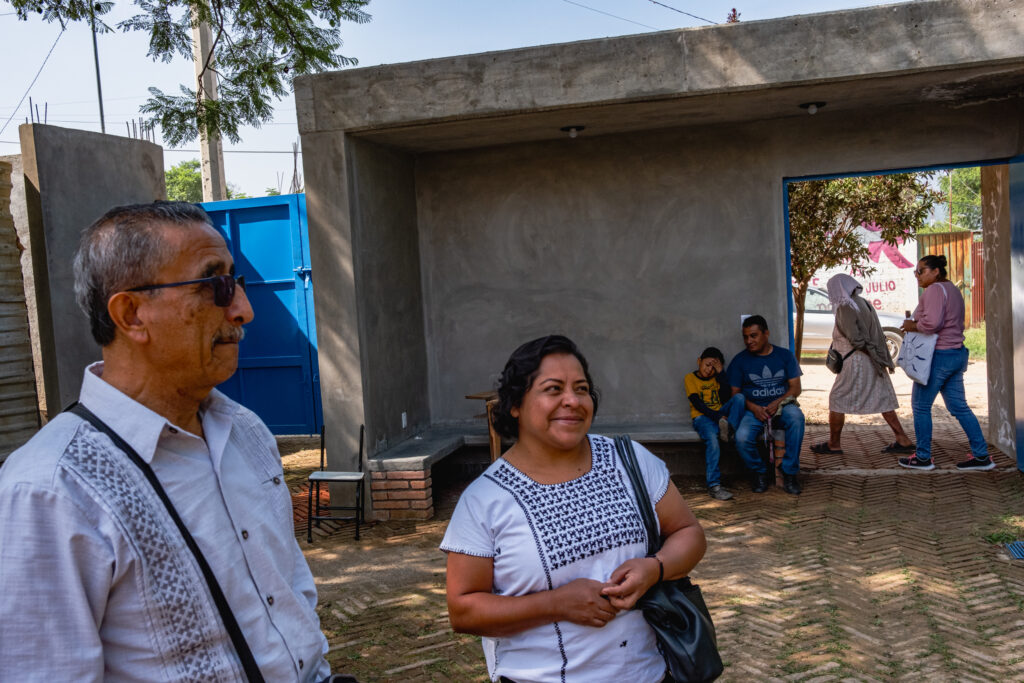
Along the concrete road, this part of Oaxaca City in southern Mexico looks like many local neighborhoods. Once the paved road becomes bumpier, the further uphill you drive or walk, the poverty becomes increasingly visible. Metal sheet roofs and walls are part of the landscape.
Vicente Guerrero is a community in the municipality of Villa de Zaachila, on the outskirts of Oaxaca City. About 15,000 people live here, most of whom have migrated from other parts of the state of Oaxaca. They came to work and settled down because it was cheaper than other parts of the city.
“We came here because there was no work in our village,” says 31-year-old Juviniana Perez Pura. “We came to try our luck so that our children would have more opportunities to continue their studies,” adds the mother of four children, ranging from age four to fifteen. Her twelve-year-old son, Daniel covers them every time a mototaxi – a three-wheeler used as a taxi – passes by. Here, the lady makes handmade tortillas inside her house by the road. Over there, a little corner shop offers the basics.
Vicente Guerrero is a community, is an avid guitar fan and has been attending the local School of Music Initiation Santa Cecilia for a few years now. This school, however, does not only educate musicians. It exists to bring dignity to local youth and educate happy humans.
From Idea to the First Concert
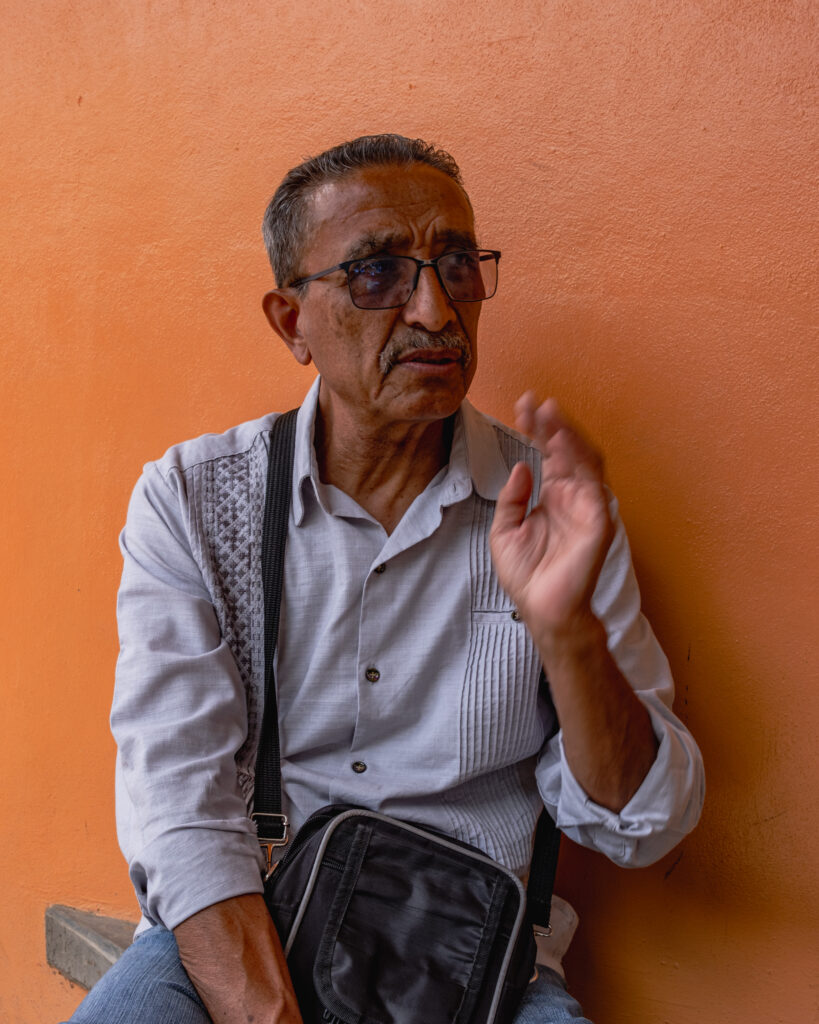
Fifteen years ago, the youth of Vicente Guerrero approached a local priest in San Bartolo Coyotepec: 69-year-old Father Jose Renteria. “They were searching for the answer to the violence in their community,” Father Jose remembers.
These children’s lives had been shaped by poverty, exclusion, lack of opportunity, and violence. Many of the local residents are often indigenous migrants from other parts of Oaxaca. As such, the community faces multiple layers of marginalization. And on top of it all, there was a landfill next to the Vicente Guerrero where all of Oaxaca City and the surrounding municipalities had been dumping garbage since the 1980s. “When we started working with the youth, one of the boys told me the only thing he saw daily was rubbish,” says Father Jose.
Living next to a landfill has created a social stigma for this community. Organized crime was also prevalent, and many young people spent their time using drugs. The violence, loss of dignity, and stigma have profoundly impacted the youth who deep down wanted better, more meaningful lives for themselves. “There were no options for them,” Father Jose continues.
Modesta Hernandez Lopez is a 43-year-old president of the school’s board of directors. “In the beginning, there was no one to help. There were only the kids, their parents, and the parish,” she says. There were also attempts by the Jesuits to help the local children, and the first group of young people who looked for Father Jose Renteria were the same people who participated in the Jesuit activities.
Initially, Father Jose invited the youth to church activities, but they showed little interest. “If he had said no to them back then, there would be no school today,” says Maria Elena Ramirez Mijangos, who is the mother of a former student and now the school’s treasurer.
Father Jose thought it was rare for the youth to come near the church, so he would not give up. “We started looking for activities that the children would like. Then the idea of music school was born,” he says. Music plays a crucial role in community life in Oaxaca, as it is present at all social events and is an integral part of the local identity.
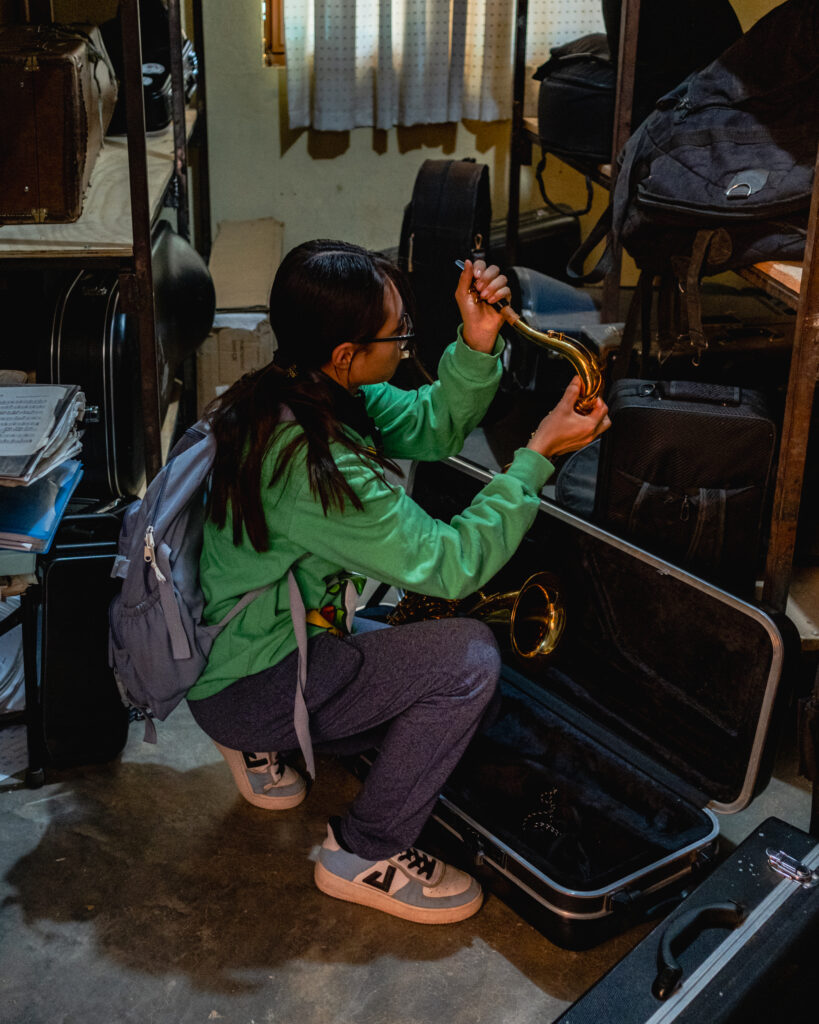
But to learn to play music, you need several things: instruments, space, and teachers.
Father Jose decided to put his efforts into finding financial support. They organized a raffle to raise money to get instruments for the first 23 students. “The first concert, when nobody knew the school, was organized in connection with a religious event. There was a large procession, and after that followed the concert,” recalls Father Jose, who from the beginning created the space for the youth to perform.
He also remembers that even then, people were already commenting that “finally something beautiful was coming out of this community, not just violence and drugs.” To him, it was a sign that the project was developing a joyful community and also giving something sacred to local children and youth: dignity.
After that, they played many more concerts, including one at the landfill that had been stripping the community of its divinity: physical health, environmental care, and emotional wellness. “The community came together and organized a concert there so that people would pay attention to the problem we live with,” says Modesta Hernandez Lopez.
Although the landfill is currently closed, its environmental impacts persist.
With the Help of Rituals and Community Effort
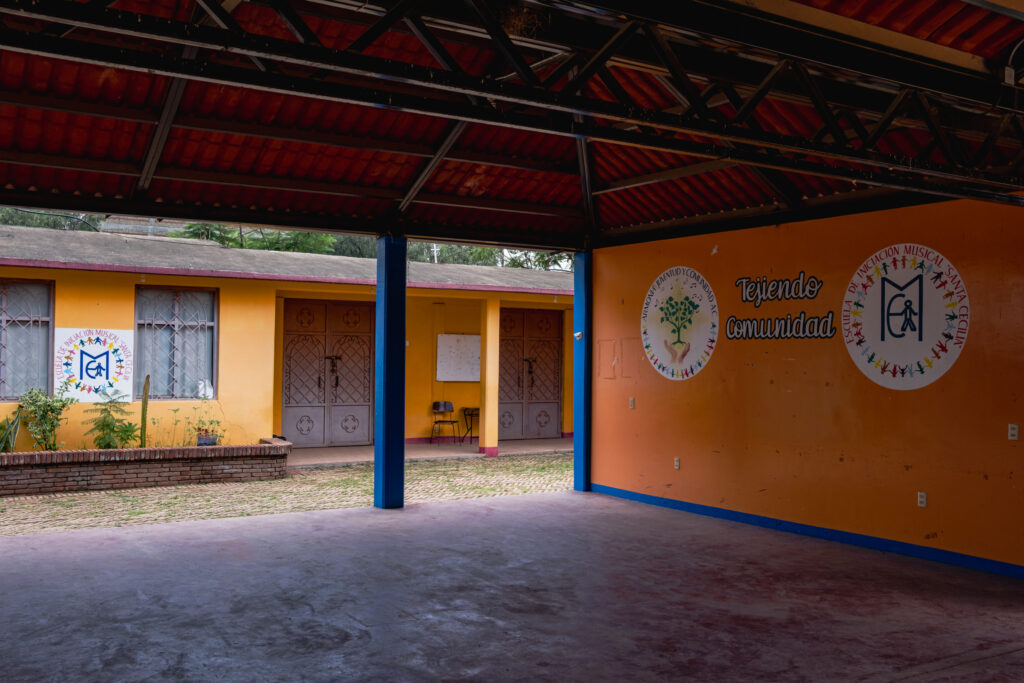
The music school’s buildings are all bright orange. “This was not here ten years ago,” recalls Father Jose. “In the beginning, the children learned to play music in the homes of people in the community.”
The classroom doors are painted blue and decorated with metal musicians. In the center of the courtyard is a covered area where concerts are sometimes held. From its start as an empty plot of land, the journey has not been easy. According to some, it has also been a demonstration of how God works.
“When we had to close the deal to buy the land, we didn’t have a single peso. I told Father Jose, ‘We have one month to give the down payment.’ He just said, ‘God will provide,’ remembers Modesta Hernandez Lopez. “And we did it. When you have faith, when you believe, things are possible,” she adds.
In a spirit of solidarity, the architect Axel Araño Díaz de la Serna developed the plans for the school, which were then carried out with the help of parents and community members. The construction was also supported by a ritual.
“In 2019, when we bought another piece of land, we had a ritual here before we started building,” says Father Jose. The ritual was performed by Carmen Santiago Alonso and Beatriz Salinas Avilés, two leaders of the local non-profit organization, Center for Indigenous Rights Flor y Canto, which has been accompanying indigenous communities in the defense of their territories and rights since 1995.
“The ritual was to thank God for the solidarity and to ask (Mother) Earth for permission to build. We wanted the works to begin in harmony with nature, with the community,” says Father Jose, and adds, “the ritual gave us strength and hope.”
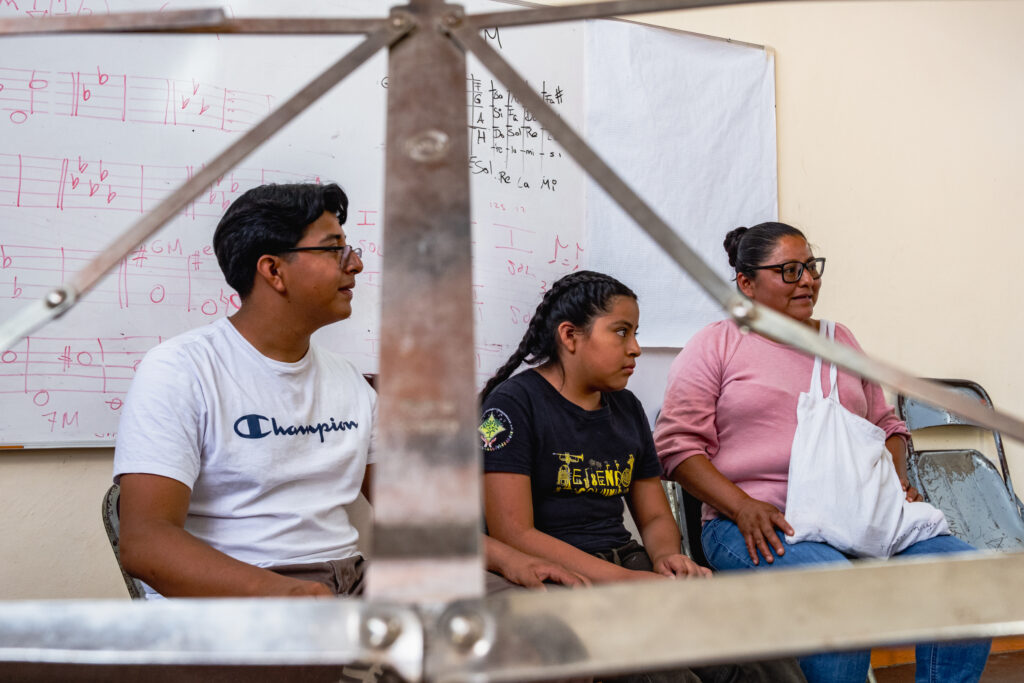
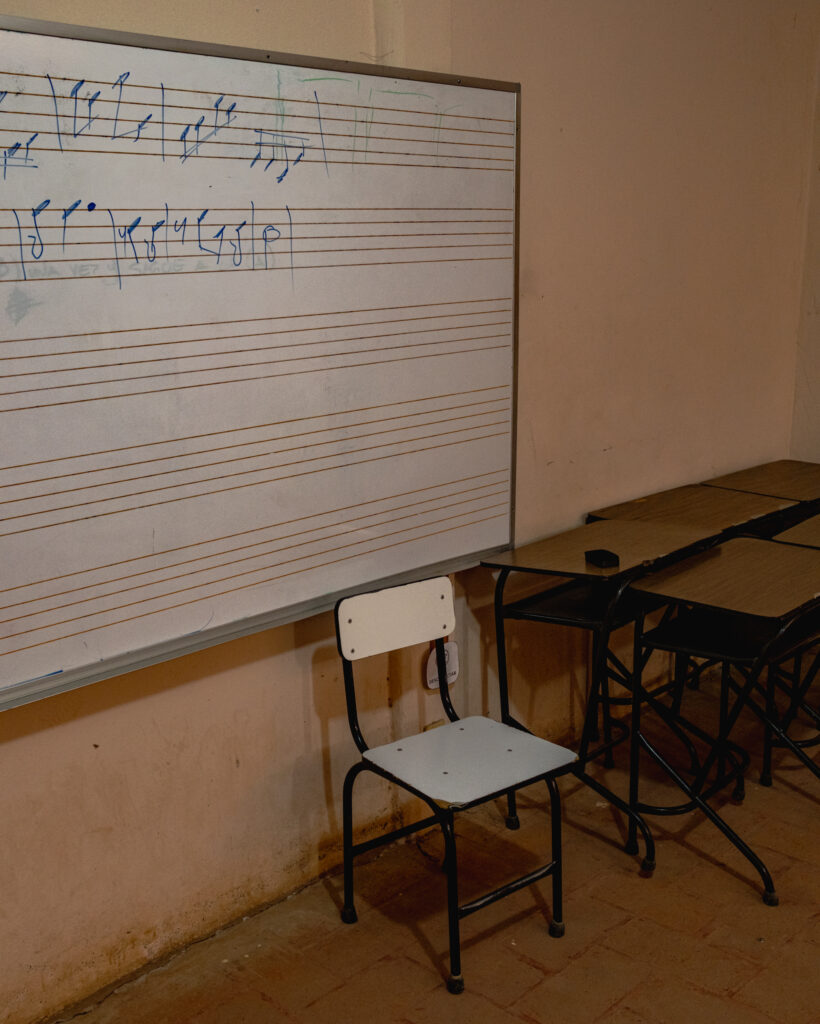
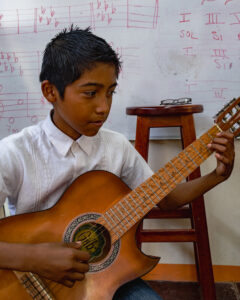
In an empty classroom, with musical notes drawn on the whiteboard and chairs placed randomly, Daniel picks up his guitar and starts to play. During July, mornings are spent practicing at the school, and students give final concerts in the afternoons. “I like the sound of the guitar,” says the 12-year-old boy, dressed in a white dress shirt and jeans.
He comes here four afternoons a week. “We have to walk 40 minutes here and 40 minutes back home,” says his mother, Juviana Perez Puna. “We cannot afford to pay for a mototaxi.”
It was Daniel’s idea to come and learn to play, and his mother agreed to it on the condition that he pay the weekly fee by himself. He saves his pocket money to pay 70 pesos, equivalent to $3.50 USD, each week to attend classes. While the school receives donations, some from foundations outside the country, each student must also pay a minimal amount of money to contribute.
“He rehearses almost every afternoon, and he had really good final grades this school year,” says Daniel’s mother. “I told him I would pay for his music lessons from now on because I see him trying,” she adds. Daniel now wants to be a guitar teacher.
Kevin Emmanuel Maya Martinez, a 17-year-old whose grandfather was also a musician, has been drawn to music since he attended preschool, says his mother, Reina Martinez Juarez, 39. Kevin and his sister both come here almost every day — one to play the trumpet, the other to master the violin. “I like the ambiance, the way we all live together here,” says Kevin, who has already played concerts in France when forty students from the symphony orchestra and a few parents went on tour in 2023. “The school has given them a lot of opportunities to see places that we, as parents, would not be able to take them to,” says Kevin’s mother, Reina Martinez Juarez.
The school not only offers new skills and passions, but also awakens children’s sense of divine dignity, helping them recognize their own inherent worth and find a sense of belonging in the community. It offers beauty and hope far beyond what their surroundings have traditionally allowed. Music has the power to unite. With spiritual support, it has created an opportunity for transformation not only for the youth but for the entire community.
Human Development for All
The role of the parents is crucial to the functioning of the project, which now has more than 150 children. Their focus is on contributing time over financial investments. The building was constructed with their help through a collective work called “tequio,” an integral part of the Oaxacan community organization. They also assist when kids play concerts outside of the community. And Father Jose is always available to step in and guide.
“He has helped me many times when I was nervous before the concert. He would tell me to focus on what I love to do,” says Kevin, who plans to continue studying music. But Father Jose has set this school on a more spiritual pursuit. “We had debates about whether we wanted to educate musicians or happy people, and we came to the conclusion that creating happy humans was our ultimate goal,” he says.
The school’s goal is to provide education and support to children who witness and appreciate the whole child, including their spirit. “We work with the missionaries of Espiritu Santo who teach the children. They also work on cultural protection and protecting children from violence, which are sensitive issues that need to be addressed among students, staff, teachers, and committees. It helps eradicate violence in these kinds of spaces,” says Maria Elena Ramirez Mijangos.
Psychologists are also available to students who would benefit from their services. “This is what we consider spirituality: to be able to receive those who need it most and allow them to develop so that they become the best of themselves within their own religions,” says Ramirez Mijangos. “The school embraces everyone, regardless of their own ideologies,” she adds.
This complex approach, which addresses all aspects of the human being, including the spiritual one, has helped restore meaning to many lives. In the last 15 years of the school’s existence, there have been several individual cases of children who were able to fight drug addiction thanks to the school’s help. The educational institution has also helped the community to stand up for itself and stand up against the organized crime groups, and find solutions to reduce the environmental impact of the landfill.
While this progress requires a collective movement, the school has been an effective catalyst. It has been a safe space for youth, provided educational opportunities, and inspired local action that has helped reduce stigmas and heal the local community. What began as a search for safety has become a sanctuary where children discover their own holy worthiness, and where they can compose a new story. One of hope, opportunity, and belonging.
Return to the Spiritual Solutions Library.