Money as Medicine: Bringing Healing and Reparations to Philanthropy
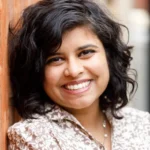
The first philanthropist Edgar Villanueva ever knew was his mother.
Edgar spent his childhood in Raleigh, North Carolina, as part of the Lumbee Tribe, one of the first tribes colonized by European Settlers nearly 500 years ago. Despite their poverty, Edgar had been surrounded by faith and service. His mother was an active member of their Pentecostal church; her commitment to serving others and her generous spirit were guiding lights for Edgar.
“I grew up with a single mother where the church was the center of our life,” Edgar says. “We were very poor, but…I don’t know that I realized that we were poor, because if we had anything to offer, we would give it.”
Inspired by his mother’s example, Edgar initially entered the seminary where he sought his own way of embodying a service-oriented life. But when he entered seminary, he began grappling with his Pentecostal faith, acknowledging internal tensions with his own spiritual practices and the tenets of the religion.
He left seminary early, returning home to North Carolina to work for a national non-profit focusing on HIV/AIDS and women’s health issues. After pursuing a master’s degree in public health, he was recruited to work for the Kate B. Reynolds Charitable Trust, the largest health foundation in North Carolina. He would be the first Indigenous person to work there.
Excited to begin his job giving back to his community, Edgar spent his days driving around North Carolina, meeting with grassroots nonprofit leaders in rural communities who were addressing community needs on the ground. He then advocated on behalf of these small organizations to the foundation’s predominantly white board. The Reynolds Family Home, a former plantation and now the foundation’s office, was a physical embodiment of the dissonance between his employers’ heritage and his intended beneficiaries.
“I didn’t even know that philanthropy existed as an industry,” says Edgar. “This entry into this institutional world was very jolting and began this spiritual journey for me that was personal, but also deeply connected to finding my purpose in work, and what philanthropy had to do with all of this. I went in there, bright-eyed and bushy-tailed, thinking that I was going to change the world and that all of the folks there wanted to do that with me and together.”
Over time, Edgar became less interested in the specific issues that were being funded and started to pay attention to how money was flowing and how funding decisions were made. This led to a disillusionment that sent him on a spiritual exploration to understand his purpose within the industry.
His book, “Decolonizing Wealth,” chronicles this journey and serves as a manifesto for foundations and philanthropists willing to repair the harm caused by wealth accumulation and offer reparations. Edgar eventually left his job at the foundation and dedicated his career to bringing an Indigenous framework to reparations and healing to the field of philanthropy.
Within the world of philanthropy, there is immense inequity in funding access. Often, Black and Indigenous grassroots organizations are overlooked due to restrictions on what is being funded and who is determining funding priorities. This is due to numerous structural factors, one of which relates to the paucity of representation within philanthropy.
According to the D5 Coalition’s 2016 State of the Work report, fewer than a third of program officers and only 8% of CEO foundations are people of color. This is even more stark when considering foundation board leadership: 85% of foundation board members are white.
Edgar argues that even when diversity efforts are in place, they don’t address the root of the problem, which is how the wealth was acquired and maintained in the first place. In “Decolonizing Wealth,” he writes: “The basis of traditional philanthropy is twice-stolen wealth — first through colonial-style exploitation of natural resources, second through tax evasion.”
As Edgar describes, “colonization” is the process of entering another’s land to extract resources and force the existing Indigenous people of that land to adopt their mindset and way of thinking. The directives of colonization — to divide, control, exploit — are rooted in white supremacy. When money is acquired through extraction, hoarding, and inequality, it acts in direct contradiction to Sacred values of love, justice, and generosity. There is no easy fix that does not require attention on healing.
The antidote, “decolonizing,” centers on healing through a process of truth and reconciliation, acknowledging the historical and ongoing impacts of colonization. In his book, Edgar outlines seven steps to healing: grieve, apologize, listen, relate, represent, invest, and repair.
This work is not limited to the individuals and communities directly affected by colonial systems. The Indigenous principle of All My Relations — “Mitakuye Oyasin,” from the Lakota tribe — means we are all related and are connected to all beings on our planet. These principles remind us that every being is at home on this planet and we all have a collective responsibility to make things right. Our suffering, healing, and thriving are intertwined.
Honoring this principle, Edgar believes in the importance of healing for everyone involved — even for those who have accumulated wealth through extractive or unjust practices, whether in the past or today. It requires acknowledgement that healing is much more than an intellectual process. It must be felt physically in our bodies, and spiritually in our souls.
“We work in a space that’s highly institutional, highly intellectual. It’s very heady, and what is missing is heart and soul work, spiritual work,” says Edgar. “We’re seeing folks who were advocates for DEI but who pulled back the work because they had it in their head and it made sense intellectually, but they didn’t have it in their heart. When you become engulfed with a sense of justice and it embodies your spirit, there is no turning around.”
Edgar acknowledges that spirituality has been a missing piece within the philanthropy space. His organization, the Decolonizing Wealth Project (DWP), prides itself on being Spirit-led. At DWP, their staff engage in ceremony together, incorporating space to acknowledge each other’s humanness as a core part of their work.
For partner organizations and foundations that seek to work with them, Edgar has seen the transformative power of this approach firsthand. When institutions create space to grieve, accept responsibility, and seek to make amends, it becomes easier for them to engage in reparative work and invest in the people who have experienced the greatest harm.
“We have had amazing results from our repair to philanthropy journey. It takes layers of peeling back, but what’s so powerful about [the process] is that it is spiritual,” Edgar says. “It is knowledge, but it’s deeply spiritual. When you go through the process of feeling in your body the harm that has been caused by wealth accumulation and the history of the institutions that we’re a part of, then it gets easier by steps six and seven, where you’re talking about investment repair.”
Carving out space for grief is powerful because it requires moving beyond the defensive mechanisms many of us have in place – denial, numbness, righteousness – to avoid the depth of pain. To honor our shared humanity, we need to make the “humanity that was invisible visible once more.”
Those who experienced the trauma and devastation of colonization need space to grieve for their people. Those who have embodied and sustained colonization also need space to grapple with guilt and the messiness of their privilege. This is not easy work. Yet Edgar knows we cannot skip this painful process of acknowledging the atrocities that have occurred. Even though it may feel unexpected for an organization focused on philanthropy to ensure there is space for these embodied emotions, Edgar believes their mission is tied to a deeper deficit in American culture: the absence of spiritual nourishment.
“We are experiencing just a famine of spiritual nourishment in this country. Our hope, and what we know we’re doing at DWP every day, is that we’re feeding people’s spirits,” says Edgar.
The Decolonizing Wealth Project has significantly impacted the philanthropic landscape in the US. The Project has worked with individual donors and large foundations such as the Bush Foundation and the Novo Foundation. To date, they have returned nearly $1 billion in funds back to Black and Indigenous communities.
“When something is broken, it needs to be fixed. It’s not about just moving the money but embodying the spirit of repair,” Edgar says. “Doing this not only impacts the communities that are benefiting from those resources and reparative action, but also those who come from the lineage of the oppressor. You see the liberation that comes to those families being freed from that guilt and that shame.”
The Robert Wood Johnson Foundation (RWJF) is one example. Dedicated to addressing health as a right and committed to dismantling structural barriers, particularly structural racism, RWJF has collaborated closely with Edgar and the Decolonizing Wealth team to build their “Truth, Repair, and Transformation” process.
Fiona Kanagasingam, Chief Equity and Culture Officer at RWJF, has direct experience implementing the framework. “We embarked on a truth, repair, and transformation process in 2023,” she says. “[At the time], we spoke to Edgar and his team about the work that they were doing around reparative philanthropy. It’s really looking at how we think about the origins of wealth and moving money in ways that restore power and resources to communities who have been most excluded and impacted, including in philanthropy.”
Over the past two years, the RWJF Truth, Repair and Reconciliation team has been coming to terms with difficult realities regarding how the foundation acquired its money. They are now in the process of revealing these truths internally to staff and board members, with plans to eventually share externally. Fiona is hopeful this will align their future priorities.
“This work goes much deeper to question the core of who we have been, and many ways in which our history is present in our choices that we make, the kinds of funding priorities that we have taken on, our endowment, and what we have prioritized in terms of financial returns over aligning our endowment with mission,” Fiona shares. “I feel excited about what’s possible once we move through a lot of the messiness and challenge of trying to do this work.”
In addition to direct work with foundations, Decolonizing Wealth has a membership community called Liberated Capital, a collection of aligned donors interested in reparative action. This group of 700 members has collectively redistributed 23 million dollars back to Black and Indigenous communities.
Hilary Giovale, a reparative philanthropist and member of Liberated Capital, describes this community as a “cross-race, cross class community of people who are interested in putting money toward racial healing and reparations.”
Citing a study by Decolonizing Wealth on public perception of reparations, she shares that “the most healing and most important message is that reparations are a form of healing for everyone. That is the zeitgeist of liberated capital. Everyone who’s part of it is operating from that understanding and moving toward that goal and that vision.”
Over the next decade, Edgar and his team have ambitious plans to continue pushing the field of philanthropy. They recently revealed their “10 Year Moonshot plan” to unlock $1 trillion towards reparative giving and continue working with similarly minded foundations and community members.
As he reflects on the success of the Decolonizing Wealth Project, Edgar shares the expansive definition of medicine in Indigenous spirituality. In Native traditions, medicine is a way of achieving balance; for something or someone to serve as medicine, it only needs to be granted spiritual power. You must listen for its sacred power; it cannot be forced. Even though it has been a winding journey to get here, he truly believes that “money” is his medicine.
Edgar encourages us to remember the origin of the word philanthropy: love of people, love of mankind. If relationality and kinship were centered in how we give and receive money, he believes our world could be fundamentally different. He isn’t afraid to sound idealistic.
“The outcome of all this is that we all will have what we need. At the highest level, the sector of philanthropy as it is would not exist,” says Edgar. “We would be in a different type of relationship with each other that transcends the ‘us versus them,’ or the giver and the recipient, the donor and the grantee. This would shift understanding that capital can flow in ways that facilitate connection and belonging and well-being for all of us.”
Edgar’s work can be considered a form of sacred reconnection, restoring our world to the Indigenous worldview of kinship and reciprocity. By reframing our mindset from scarcity to abundance, we can build a world where everyone’s needs are met, where we honor our planet and all living beings. We can create an economic system that enables collective thriving.
Return to the Spiritual Solutions Library.